longshore
A coast, some fish, and whoever you can hear. Nothing is at stake and nothing decays.
What it is
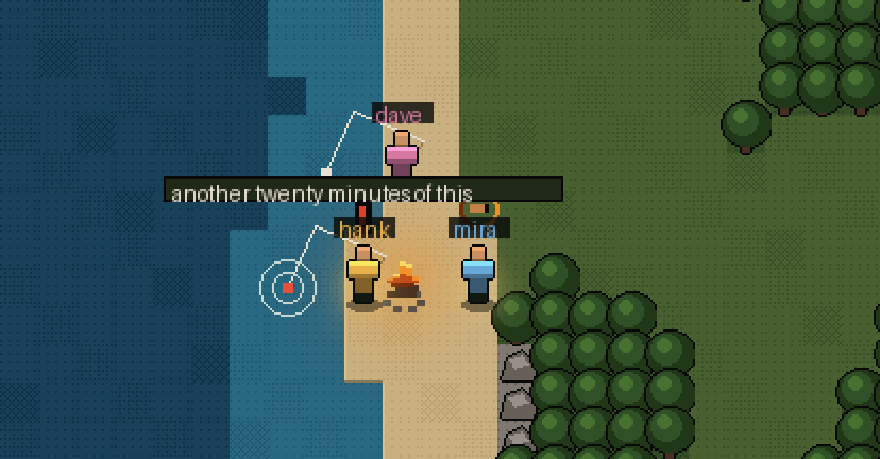
You walk about, you fish, and you talk to whoever else is there.
It runs over LoRa radio on loraline, so the people on the shore with you are the people your antenna can reach. No server, no account, no internet.
Two numbers go up and both are yours alone. How many kinds you have ever caught, which stops moving once you have seen most of them. And your fishing, which goes up with every fish and has no last level: an evening reaches about six, a year about twenty-two.
Neither is ever sent anywhere. If you want to know somebody's you have to ask, and they can lie, and nobody minds. A number on the wire is a leaderboard whether anybody meant one or not.
The opposite of catacomms
catacomms is four minutes, everybody present, every machine agreeing on one room to the byte. That needed turn locking, state hashes and divergence detection, because a disagreement there would matter.
Here nobody is racing anybody and my catch does not change your water. So there is no consensus to reach and no engine to keep in step. You keep your own state, your position rides along on a heartbeat, and a second-old view of where somebody is standing is good enough.
That has a side effect worth having. Somebody at the edge of your range updates slowly and vaguely; somebody standing beside you updates smoothly. How clearly you can see another person depends on how well your radios hear each other.
The coast
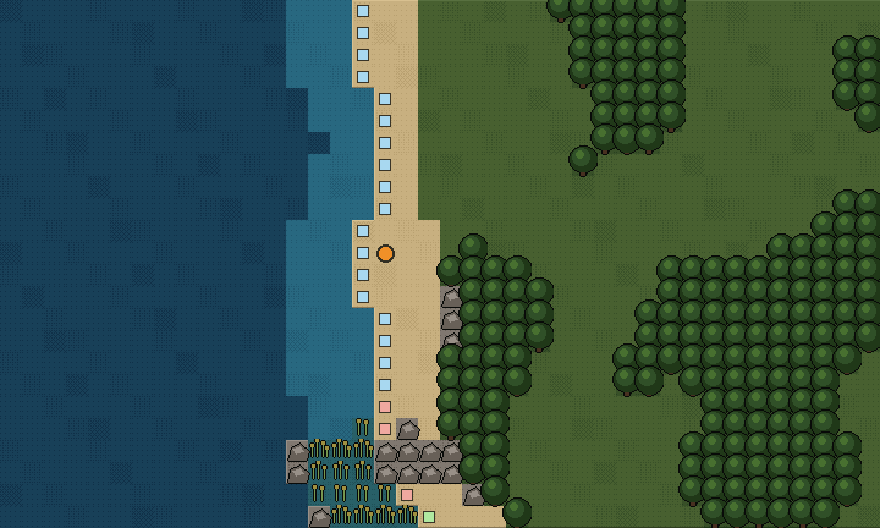
Derived from a seed and never transmitted. Everyone who types the same
--coast is on the same coastline without a byte crossing the air.
Bays, headlands, reed beds, rocks standing out of the water, and the odd island
you cannot walk to.
The fish
Forty-two species across four waters. What is biting depends on where you sit, the hour and the month, so a year has a shape and so does an afternoon.
| water | some of what lives there |
|---|---|
| open sea | herring, mackerel, cod in winter, and a moonfish once in a very long while |
| shallows | dab, flounder, bass at dusk, glass eels in spring |
| reeds | roach, perch, pike, and a wels catfish on a summer night |
| rock ledge | wrasse, conger after dark, red mullet in late summer |
Across a whole coast and a whole year: 40% common, 38% uncommon, 8% scarce, 2% rare, 13% boots and driftwood. A given spot at a given hour is lopsided, which is the reason to get up and walk somewhere else.
A cast is derived from the place, the day, the hour and a salt, so anybody can check that a cast produced what was claimed.
Fishing
Tap the water to fish it and you walk to the nearest place you could cast from, and cast when you arrive. Tap the land to walk. Tap again to strike.
A bite comes in seven to twenty-four seconds, and you have under three seconds to strike. Walking away cancels the cast, and that is the only mistake available to you.
When something takes the float it turns red and throws ripples, and a mark appears over your head so the others can see it. On the strike the name and size float up and fade, and land in your log. Somebody else landing one shows the same way over their head, because the name and the size are already in the fourteen characters riding on their heartbeat.
What anybody says appears above them as well as in the panel. There is sound, synthesised in the page: a plop on the cast, a knock when something takes it, a lift when you land one. The knock is the one that matters, because you will be looking somewhere else.
The fire
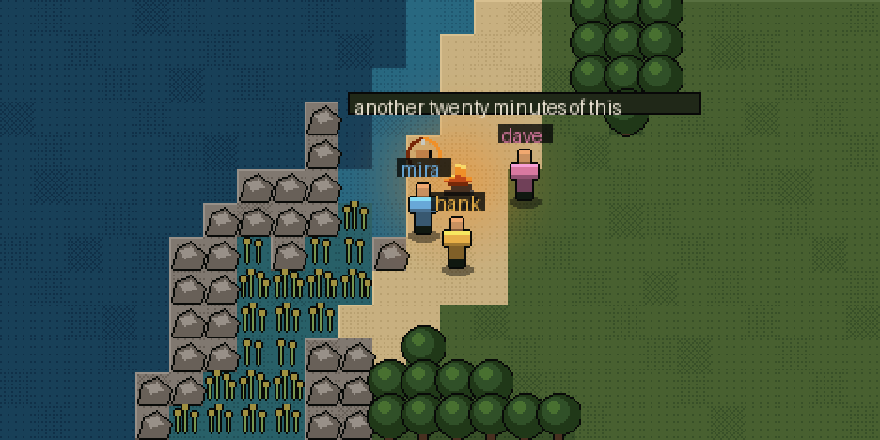
Every coast has one, where the fishing is, and the seed decides where. Nobody places it and nobody is told.
It is lit while people are near it and out when they are not, and that costs nothing. There is no tending, it does not go out while you are away, and you cannot come back to a cold one. A fire that needed feeding would be decay with a flame on it.
Put your last catch on and everybody nearby sees what it is. Nothing is gained by cooking and nothing is lost; it is a reason to walk over to where the others are. It burns driftwood, which is what you catch when you catch nothing.
What it can't do
Six people, and no strangers
Everyone announces themselves periodically, and if two transmit at once both packets are lost. Nobody is going to wander in because they happened to be online. A coast with nobody on it is not peaceful, it is empty.
Fishing, and nothing else
No crafting, no building, no second skill. With four people a second activity splits the group, and being together is the point.
The band is yours to get right
It transmits on licence-free spectrum that differs by country. Read loraline's setup first.
Getting it
longshore is inside the loraline app, in the switcher across the top. One download, one radio, one setup, and the chat on the shore is the same conversation as everywhere else.
You can be standing on the coast in about two minutes with nothing but a laptop. Fishing alone needs nobody to talk to, so it needs no radio.
Get it Download the app, plug in a module, put a line in.